Host visibility
See whether host capture evidence was returned from the Common Crawl collection reported by the lookup.

 MAXPlaces Labs · Free Chrome extension
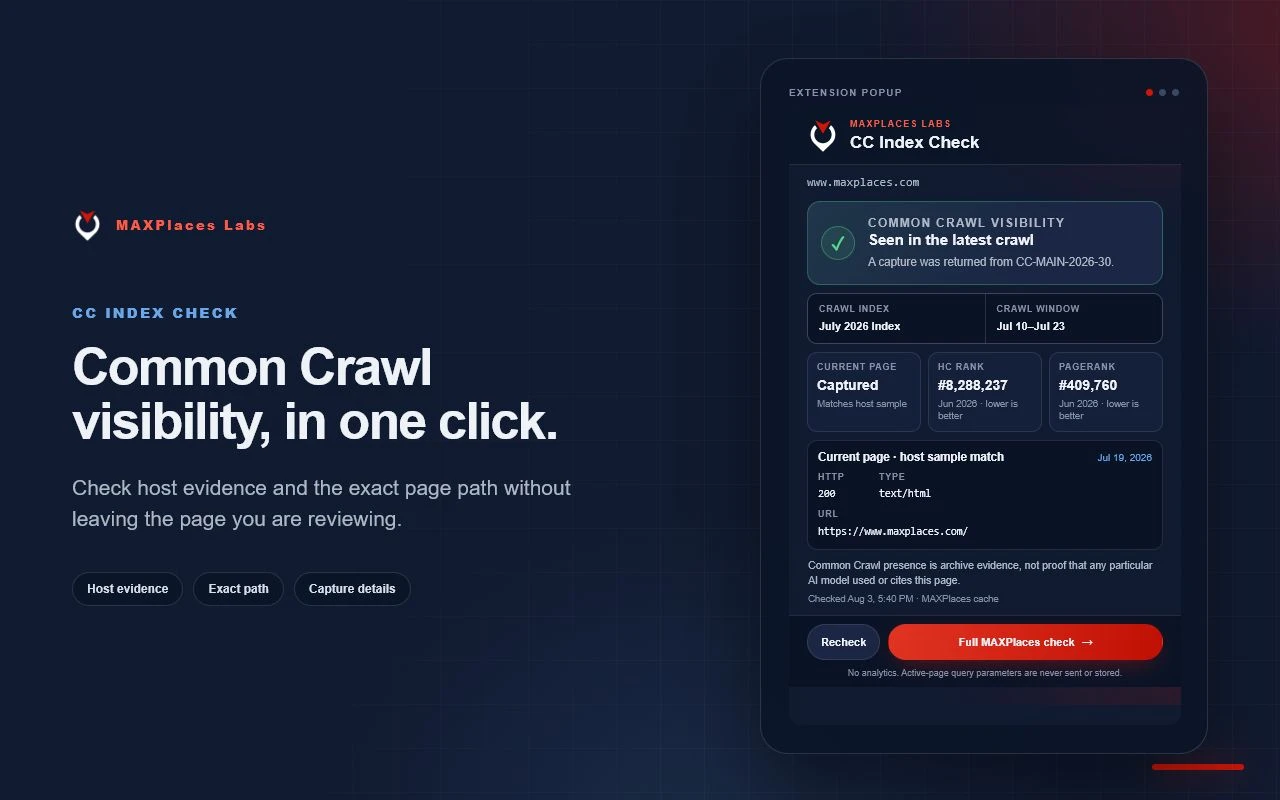
See host evidence, exact-page capture status, crawl details, HC Rank, and Common Crawl WebGraph PageRank—without leaving the page you are reviewing.
Free · No account · Available now in the Chrome Web Store
A fast evidence check
CC Index Check keeps the answer compact while preserving the distinctions that matter: site versus page, evidence versus inference, and unknown versus absent.
See whether host capture evidence was returned from the Common Crawl collection reported by the lookup.
Check the sanitized exact URL and path without transmitting embedded credentials, queries, or fragments.
Review the capture date, returned URL, HTTP status, and MIME type when trustworthy evidence is available.
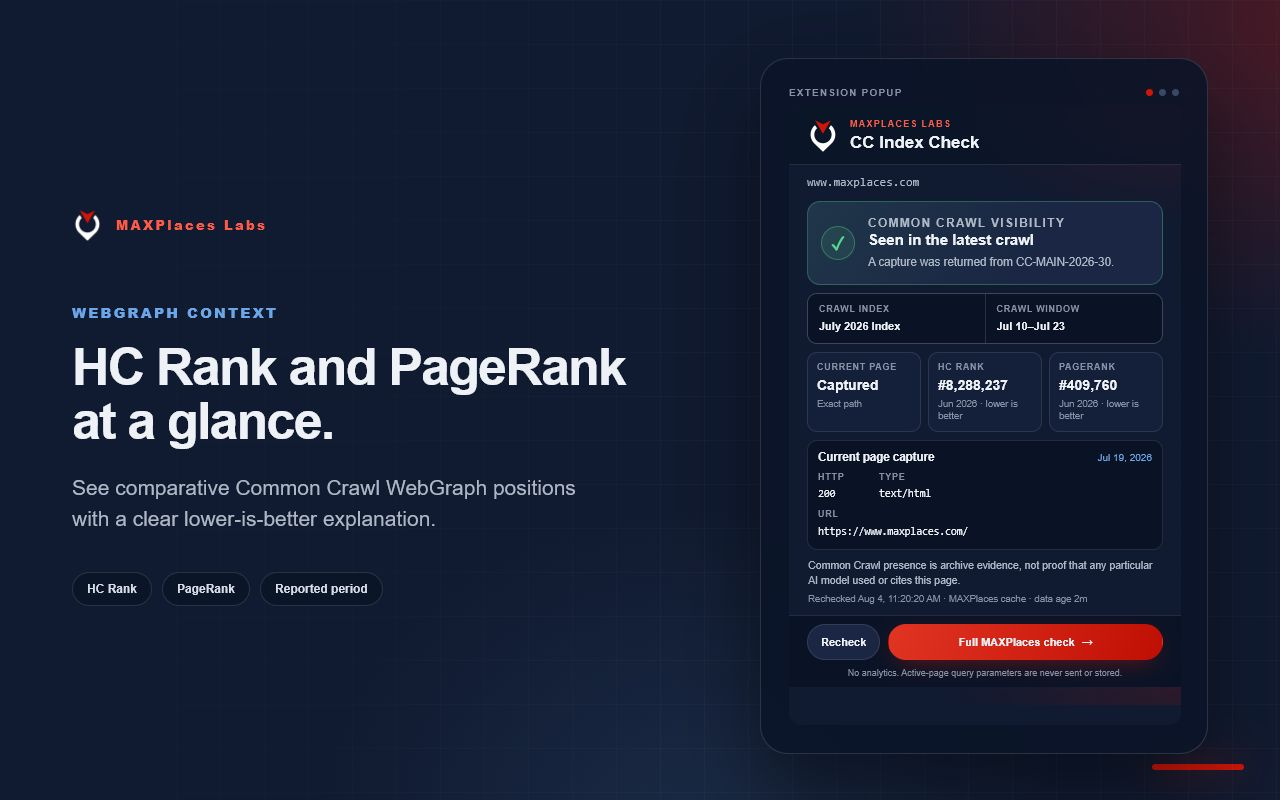
View HC Rank and PageRank positions reported for the identified Common Crawl WebGraph period.
Inside the extension
How it works
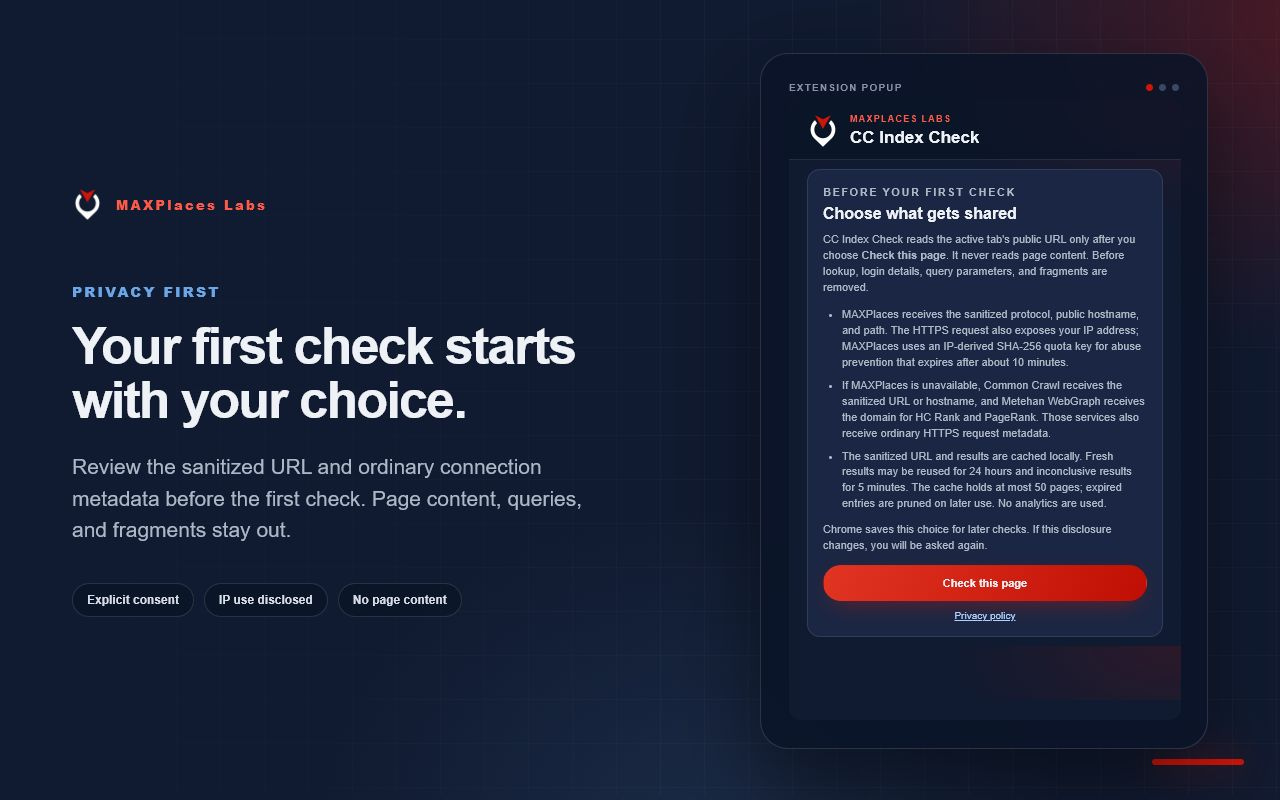
First use requires an explicit choice. After that, clicking the extension icon starts a check for the public page you selected.
Review the complete URL and provider data flowOn first use, read the disclosure and choose Check this page. Later openings check automatically.
Credentials, the entire query string, and the fragment are removed. Page content is never read.
MAXPlaces provides the primary quick check, with direct Common Crawl and Metehan fallback only when needed.
Saved-local, provider-cache, direct-fallback, unavailable, and last-confirmed results remain distinguishable.
Interpret results correctly
A qualifying matching capture was returned from the identified Common Crawl collection.
No qualifying capture was returned by the reported lookup. This does not cover every historical release.
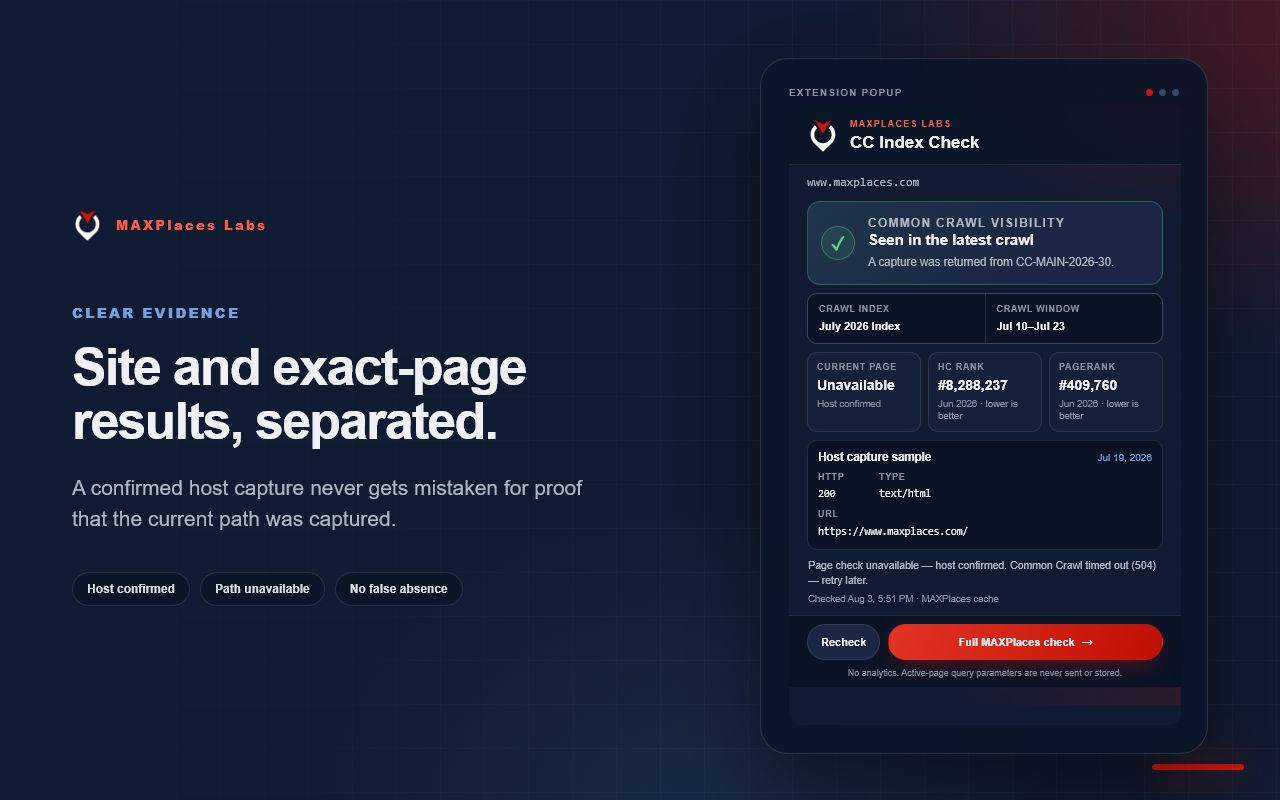
A timeout, rate limit, malformed response, or provider error is not evidence that the page is absent.
Common Crawl presence cannot prove that a particular AI company, dataset, model, search engine, or answer system trained on, retrieves, cites, or recommends the page.
Extension privacy by design
The extension keeps a minimal consent-version record and a bounded local result cache. It does not sell browsing activity, build advertising profiles, determine creditworthiness, or monitor background browsing.
Internet requests expose ordinary connection metadata, including the client IP address, to each recipient. MAXPlaces uses an IP-derived SHA-256 quota key for abuse prevention that expires after approximately 10 minutes. Direct fallback providers receive ordinary request metadata under their own policies.
Common questions
The extension is intentionally narrow: quick Common Crawl evidence and reported WebGraph context for the page in front of you.
It checks the current public site and sanitized exact-page URL for evidence from the reported Common Crawl collection. It also displays capture details and HC Rank and PageRank positions from the reported Common Crawl WebGraph period.
Open a supported public HTTP or HTTPS page, then open the extension. On first use, review the disclosure and select Check this page. Later checks start when you open the popup.
No qualifying capture was returned from the collection covered by that lookup. It does not mean the page was never crawled, and it is not a Google indexing result.
Host-level and exact-page evidence are separate. Common Crawl may contain another URL from the site while the current path has no returned capture, or the exact-page provider may be temporarily unavailable.
They are comparative positions calculated from Common Crawl WebGraph data. Lower numbers indicate a stronger position within the reported ranking set. The displayed PageRank is not a Google Search ranking or the discontinued Google Toolbar PageRank.
No. A capture is web-archive evidence only. It cannot prove that any AI company, dataset, model, or answer system trained on, retrieved, cited, or recommended the page.
After consent, it reads the active page URL and removes embedded credentials, the query string, and the fragment. The remaining protocol, hostname, and path support the lookup. Internet requests also expose ordinary connection metadata, including the client IP address, to each recipient. MAXPlaces uses an IP-derived SHA-256 quota key for abuse prevention that expires after approximately 10 minutes. The extension never reads page content or background browsing history.
CC Index Check
Free, focused, and careful about the difference between archive evidence and unavailable data.
CC Index Check is an independent MAXPlaces Labs utility and is not affiliated with or endorsed by Google, Chrome, Common Crawl, or Metehan WebGraph.